
Acceptance and Commitment Therapy (ACT) at Fox Valley Institute
At Fox Valley Institute for Growth and Wellness in Naperville, our therapists use Acceptance and Commitment Therapy (ACT) to help teens and adults make room for hard thoughts and feelings and move toward what matters to them. ACT was developed by Dr. Steven C. Hayes in the late 1980s. Instead of fighting painful thoughts, you learn to notice them, let them be and still take steps toward the life you want. Your therapist helps you name your values and build habits that match them. Call (630) 718-0717, and an intake coordinator will check your insurance before your first visit.
Acceptance and Commitment Therapy (ACT) is a modern form of talk therapy that teaches you to stop fighting your hardest thoughts and feelings, and start living a life that matters to you.
At
Fox Valley Institute in Naperville, our therapists use ACT to help clients break free from emotional struggle and reconnect with their values. This guide walks you through what ACT is, how it works, and how to know if it is right for you.
What Is Acceptance and Commitment Therapy (ACT)?
ACT (said as “act,” one word) is a third-wave cognitive behavioral therapy. It belongs to the same family as CBT and DBT, but takes a different angle.
Instead of trying to delete bad thoughts, ACT helps you accept them, unhook from them, and act on what matters most.
The aim is psychological flexibility: the ability to feel hard emotions and still move toward the life you want.
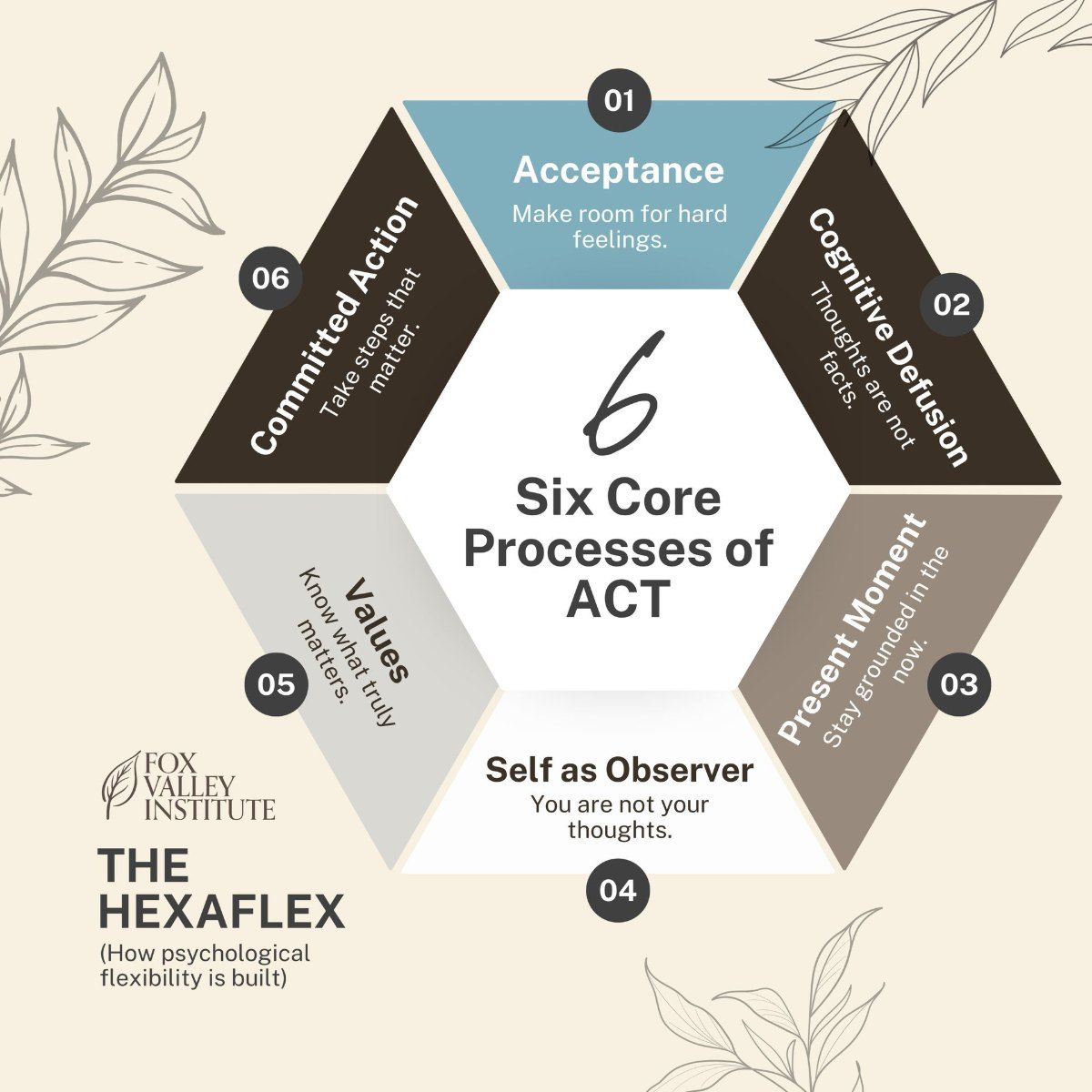
Six Core Processes of ACT, Also Known as “The Hexaflex”
ACT is built on six skills shown as a six-sided shape called the Hexaflex.
Who Created ACT? The Origins
ACT was developed in the late 1980s by Dr. Steven C. Hayes, an American psychologist who built the approach after his own struggle with panic attacks. It is grounded in Relational Frame Theory (RFT), which studies how language and thought shape human suffering.
The Principle Behind ACT
The core principle: trying to control or get rid of painful thoughts and feelings often makes them stronger.
ACT flips the question. Instead of “How do I stop feeling this?” it asks, “What kind of life do I want, and how can I move toward it, with these feelings along for the ride?”
Goal of Acceptance and Commitment Therapy
By the end of treatment, you should be able to:
- Accept hard emotions without being controlled by them
- Step back from unhelpful thoughts instead of believing everyone
- Stay grounded in the present moment
- Identify your deepest values
- Take consistent action toward what matters most
How Does Acceptance and Commitment Therapy Work?
ACT works by changing your relationship with your thoughts, not the thoughts themselves. Your therapist guides you through three shifts.

ACT Therapy Techniques and Interventions
ACT is experiential, not just talk-based. Therapists use stories, metaphors, and short exercises to make ideas click.
Cognitive Defusion
Learning to see thoughts as words, not truths. A common exercise: repeat the thought “I am a failure” out loud 20 times fast until it loses its punch.
Mindfulness Practices
Short breathing and grounding exercises that bring you back to the here and now.
The Observer Self
Exercises that help you notice you are the one watching your thoughts, not the thoughts themselves.
Values Clarification
Worksheets and conversations that uncover what matters most across family, work, health, and growth.
Committed Action Planning
Setting small, doable goals that move you toward your values, even when emotions are loud.
Metaphors and Stories
Powerful images, like passengers on a bus or leaves on a stream, teach big ideas in simple ways.
ACT Exercises You Can Try at Home
- Leaves on a Stream: Picture each thought floating by on a leaf. Watch it drift past.
- Passengers on the Bus: Your thoughts are loud, passengers. You are the driver; you choose the direction.
- Values Compass: Write the four areas of life most important to you and one tiny action for each this week.
- Name the Story: When a familiar painful thought shows up, label it. (“Ah, there’s the ‘I'm not good enough’ story again.")
5-4-3-2-1 Grounding: Name 5 things you see, 4 you can touch, 3 you hear, 2 you smell, 1 you taste.

ACT Books, Workbooks, and Apps
Books:
- The Happiness Trap by Russ Harris
- Get Out of Your Mind and Into Your Life by Steven C. Hayes
- A Liberated Mind by Steven C. Hayes
- ACT Made Simple by Russ Harris
Workbooks:
- The Mindfulness and Acceptance Workbook for Anxiety
- The Mindfulness and Acceptance Workbook for Depression
Apps:
- ACT Companion
- Stop, Breathe & Think
- Insight Timer

Is Acceptance and Commitment Therapy Evidence-Based?
Yes. Hundreds of clinical trials support ACT.
- The American Psychological Association recognizes ACT as an evidence-based treatment for chronic pain, depression, OCD, and anxiety.
- A 2023 meta-analysis in the Journal of Contextual Behavioral Science found that ACT produces outcomes similar to CBT across most conditions.
- ACT shows strong long-term results for chronic pain, addiction, and treatment-resistant depression.
- Brief ACT (4 to 8 sessions) can also produce real change.
Strengths and Limitations of ACT
Strengths
- Backed by hundreds of clinical studies
- Often helps clients who did not fully respond to CBT or medication
- Skills last well beyond therapy
- Works in person or through telehealth
- Builds a life of meaning, not just symptom relief
- Pairs well with CBT, DBT, EMDR, and medication
Limitations
- Can feel abstract at first
- Requires real practice between sessions
- May feel slower than CBT for sharp, urgent symptoms like panic attacks
- Less structured for clients who want a clear weekly plan
- Severe depression, psychosis, or active crises usually need additional treatment
ACT vs. CBT and Other Therapies
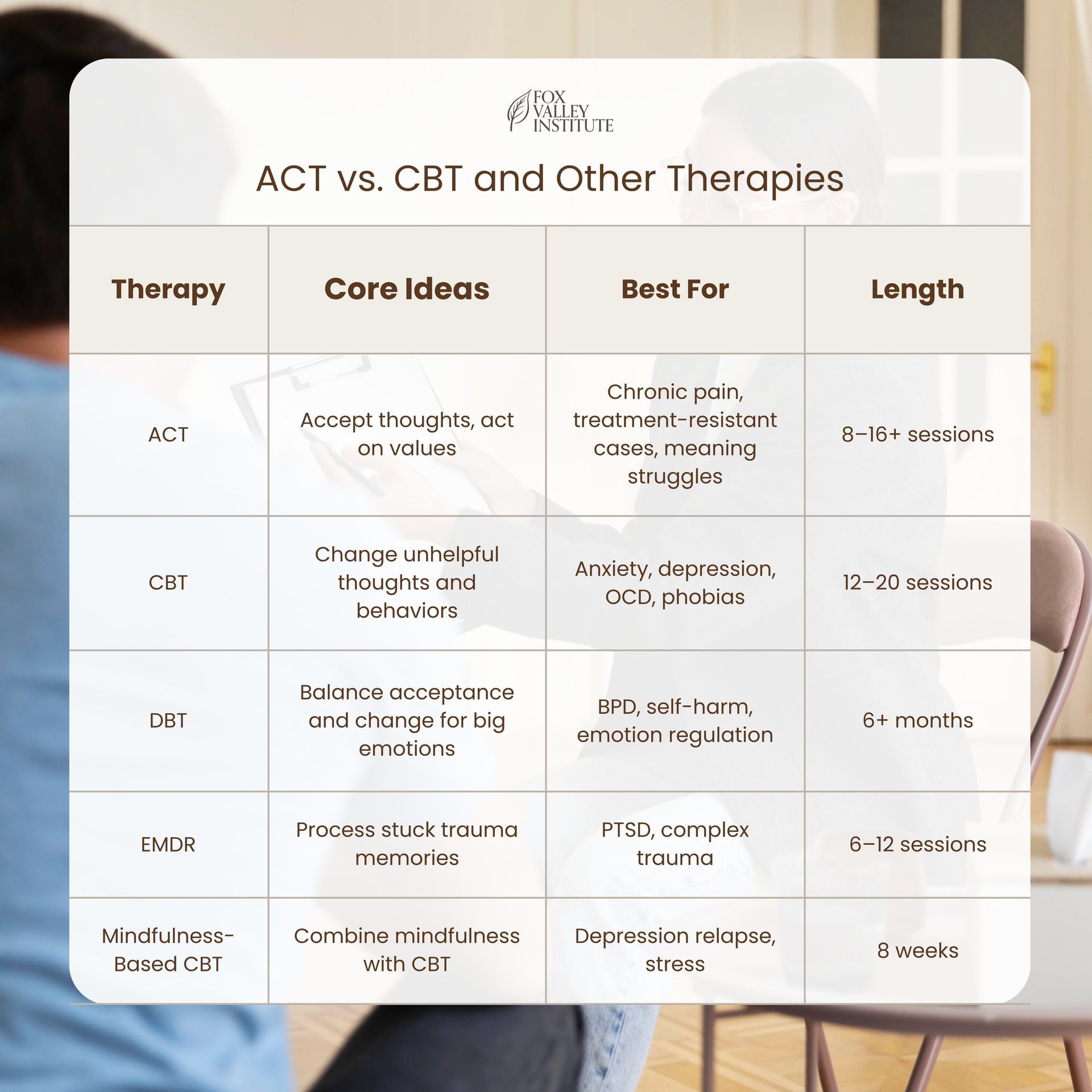
ACT vs. CBT in one line: CBT changes thoughts. ACT changes your relationship with thoughts.
What to Expect in ACT Therapy?
Your First Session
Your therapist asks about what brought you in, your history, and what kind of life you want to build. You may complete short questionnaires that assess stress, mood, and avoidance patterns.
Early Sessions (Weeks 1–4)
You start with mindfulness and defusion exercises. Expect to do values work early; clarifying what really matters in family, work, health, and growth.
Middle Sessions (Weeks 5–10)
You face old patterns, sit with hard feelings in safe doses, and take small actions that match your values. Metaphors like passengers on the bus make the work concrete.
Between Sessions
You get small practice tasks: mindfulness exercises, values journals, or one tiny values-based action each week.
Final Sessions
You and your therapist review progress, plan for future setbacks, and lock in the skills you built. Many clients leave with a clear “values playbook” to return to anytime.
How Long Will I Need Acceptance and Commitment Therapy?
ACT length depends on your goals and history. Most clients fall into one of three timelines.
Brief ACT (4 to 8 Sessions)
Good for focused issues like a specific phobia, mild work stress, or a single life transition.
Standard ACT (8 to 16 Sessions)
The most common length. Fits anxiety, depression, OCD, mild PTSD, and people who feel “stuck” but are high-functioning.
Long-Term ACT (6 Months or More)
Used for chronic pain, complex trauma, treatment-resistant depression, addiction, and major life rebuilds.
What affects your timeline:
- The depth and length of your struggle
- Whether you have other diagnoses
- Your between-session practice
- How clearly defined are your values and goals
- Life events that come up during therapy
Many clients also return for short “tune-up” sessions during big life changes.
Recovery and Outlook
Recovery in ACT looks different from many other therapies. The goal is not to feel happy all the time; it is to live a rich, meaningful life, even when hard feelings show up.
What Recovery Looks Like
- You notice unhelpful thoughts without being ruled by them
- You feel difficult emotions without running from them
- You bounce back from setbacks faster
- You feel more present in your daily life
- You build relationships, work, and habits that reflect your values
Long-Term Outlook
Research shows ACT skills tend to last well beyond therapy, with clients reporting continued growth at 1, 3, and even 5 years after treatment. For chronic conditions, ACT does not promise symptom-free living; it delivers the freedom to live well, even when symptoms appear.
Setbacks Are Normal
Setbacks are not failures. They are part of being human. Some clients schedule short check-ins every few months to stay grounded during big life changes.
What to Consider Before Starting ACT
- Be open to feeling. ACT asks you to make room for hard emotions rather than avoid them.
- Expect practice. Real change comes from doing the work between sessions.
- Trust the process. Metaphors and mindfulness exercises take getting used to.
- Pick the right therapist. Look for one trained specifically in ACT.
- Check your insurance. Most plans cover ACT.
- Give it time. Most clients need 6 to 8 sessions before deeper shifts kick in.
How to Get Started with ACT in Naperville
Our team of psychologists, social workers, and licensed therapists will match you with an ACT clinician who fits your goals. We serve Naperville, Aurora, Wheaton, Lisle, Plainfield, and the greater Fox Valley area, with in-person and secure telehealth sessions across Illinois.
Three steps to begin:
- Reach out by calling, emailing, or using our website.
- Get matched: our intake team pairs you with the right ACT therapist.
- Book your first session: in person or online.
Contact Fox Valley Institute:
- Call: (630) 718-0717
- Email: clientcare@fvinstitute.com
- Visit: 640 N River Rd Ste 108, Naperville, IL 60563
- Insurance: View accepted plans
If anxiety, depression, chronic pain, or feeling stuck is running your life, ACT can help you reconnect with what truly matters.
Book a session with Fox Valley Institute to begin.
Find a therapist in Naperville
Visit our staff page and easily find a therapist that aligns with your unique needs and preferences.

What others say about us
Frequently Asked Questions About Acceptance and Commitment Therapy
What is Acceptance and Commitment Therapy (ACT)?
ACT is a form of talk therapy that teaches you to stop fighting your hardest thoughts and feelings and start living a life that matters to you. It belongs to the same family as CBT and DBT.
What happens in ACT sessions?
You will practice mindfulness, learn to see thoughts as words rather than truths, and get clear on what matters most to you. Between sessions, you may have small practice tasks, like a short mindfulness exercise or one values-based action.
How long does ACT take?
It depends on you and your needs, so there is no set number of sessions. You and your therapist will talk about your progress along the way.
Can I do ACT by Telehealth?
Yes. Adults and college students anywhere in Illinois can do ACT by Telehealth and keep the same therapist. Counseling for children and teens takes place in person at our Naperville office.
Can I do ACT if I take medication?
Yes, ACT can be used alongside medication from your own doctor. Our therapists and psychologists do not prescribe or manage medication.
How do I get started with ACT?
Call (630) 718-0717. An intake coordinator will check your insurance, match you with a therapist and find an opening for your first appointment.