
Cognitive Behavioral Therapy (CBT) at Fox Valley Institute
Everything You Need to Know Before Your First Session. A Complete Guide for Naperville
At Fox Valley Institute for Growth and Wellness in Naperville, our therapists use Cognitive Behavioral Therapy (CBT) to help children, teens and adults change the thought patterns that keep them stuck. CBT is built on a simple idea: thoughts, feelings and actions are connected, so changing one can change the others. Your therapist helps you notice unhelpful thoughts, test them and practice new ways to respond. Call (630) 718-0717, and an intake coordinator will check your insurance before your first visit.
If your mind feels stuck in worry, sadness, or fear, Cognitive Behavioral Therapy (CBT) can help you regain the level of control you are looking for. CBT is one of the most studied talk therapies in the world, and it works by changing how you think, feel, and act, in that order.
At
Fox Valley Institute in Naperville, our CBT therapists help adults, teens, kids, and couples build real skills for real life. This guide covers what CBT is, how it works, who it helps, and how to get started.
What Is Cognitive Behavioral Therapy (CBT)?
Cognitive Behavioral Therapy is a structured, short-term form of talk therapy. It blends two methods:
- Cognitive therapy (changing thoughts)
- Behavioral therapy (changing actions)
CBT focuses on the present, not endless deep-diving into the past. You and your therapist set clear goals, then build skills you can use right away; at work, at home, or in your own head at 3 a.m.
CBT is used for everything from mild stress to serious mental health conditions.
Most people see real progress in 12 to 20 weekly sessions, in person or through online CBT.
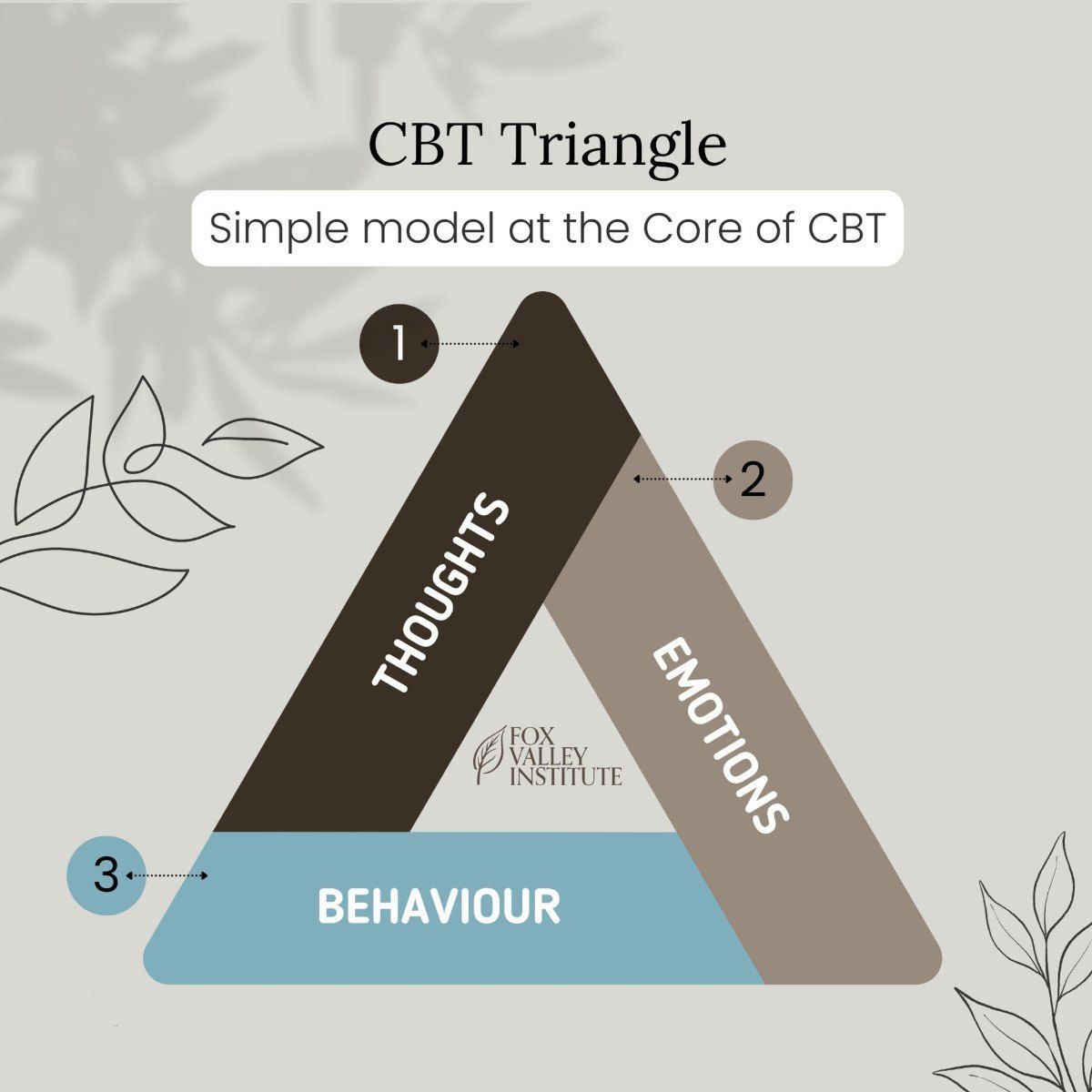
The CBT Triangle
The cognitive behavioral therapy triangle is the simple model at the core of CBT. It shows that your thoughts, feelings, and behaviors are linked; each one shapes the next.
For example, the thought “I will fail this presentation” creates dread, which leads to skipping prep.
Skipping prep then “proves” the thought right.
Break the loop at any point, and the whole pattern shifts:
- Change the thought → feelings and actions soften
- Change the behavior → confidence grows, and thoughts update
- Calm the feeling → clearer thinking returns
This triangle is why CBT works so fast for many people.
Small shifts ripple through the whole system.
Who Created CBT? A Short Backstory History
CBT was not the work of one person. It grew from the ideas of two psychologists working in parallel during the 1950s and 1960s.
Dr. Albert Ellis developed Rational Emotive Behavior Therapy (REBT) in the mid-1950s, the first true cognitive therapy.- Dr. Aaron Beck, often called the father of CBT, developed Cognitive Therapy in the 1960s after noticing patterns of negative self-talk in his depression patients.
Their work merged into modern Cognitive Behavioral Therapy.
Today, CBT has grown into a “third wave” that includes Acceptance and Commitment Therapy (ACT), Dialectical Behavior Therapy (DBT), and mindfulness-based approaches.
What Principle Underlies CBT?

Two people can face the same setback and react in very different ways, depending on the meaning they give it. CBT teaches you to spot, test, and reshape those meanings.
Goal of Cognitive Behavioral Therapy
The goal of CBT is to help you become your own therapist. By the end of treatment, you should know how to:
- Notice the thoughts that fuel your hardest feelings
- Test those thoughts against real evidence
- Replace them with more balanced, useful ones
- Build healthier habits that keep you steady long after therapy ends
How Does Cognitive Behavioral Therapy Work?
CBT works by slowing down the automatic loops in your brain. Your therapist guides you through three steps in every session.
Spot the thought: catch the unhelpful belief (for example, "I always mess things up").- Test the thought: look at the real evidence for and against it.
- Replace the thought with a more balanced, realistic one.
Over time, this rewires your brain’s response to stress, fear, and sadness. The skills stay with you long after therapy ends.
Types of CBT and Common Approaches
CBT is a family of related methods,
not a single technique. A skilled CBT therapist may blend several types of CBT in a single treatment plan.

Difference between CBT and psychotherapy: All CBT is psychotherapy, but not all psychotherapy is CBT. CBT is structured and skills-based; many other forms of psychotherapy are open-ended.
Conditions CBT Treats
CBT is one of the most flexible therapies in mental health care. It is the first-line treatment for many issues and works well alongside medication when needed.
Mental health conditions CBT helps treat:
- CBT for anxiety, panic disorder, and social anxiety
- CBT for depression and persistent low mood
- CBT for PTSD and complex trauma
- CBT for OCD and intrusive thoughts
- Phobias and specific fears
- Eating disorders and binge eating
- Substance use and relapse prevention
- Bipolar disorder (as a support tool)
- Anger and irritability
- Self-harm urges and suicide prevention
Other life challenges CBT helps with:
- Cognitive behavioral therapy for insomnia (CBT-I)
- Chronic pain and health anxiety
- Cognitive behavioral therapy for grief
- Work stress and burnout
- Low self-esteem and perfectionism
- Communication and relationship struggles
Specialized CBT for different ages and needs:
- CBT for kids and ADHD children
- CBT for teens
- CBT for young adults
- Cognitive behavioral couples therapy
- CBT for autism (focused on emotional regulation and social skills)
Core CBT Techniques
CBT is hands-on. You learn real tools, practice them in session, and use them between visits.
Here are the most common CBT techniques therapists use.
Cognitive Restructuring
Spotting thinking traps like all-or-nothing thinking, mind reading, and catastrophizing — then rewriting them.
Behavioral Activation
Scheduling small, meaningful activities to break the freeze of depression.
Graded Exposure
Facing feared people, places, or memories in slow, safe steps until the fear fades.
Thought Records
A structured journal that tracks triggers, automatic thoughts, evidence, and balanced replies.
Behavioral Experiments
Real-life “tests” that challenge your fears (for example, speaking up in a meeting to test the belief “everyone will judge me”).
Mindfulness and Grounding
Breath work, body scans, and the 5-4-3-2-1 technique to calm the nervous system in the moment.
Problem-Solving Training
Breaking overwhelming problems into clear, doable steps.
Homework Assignments
Short tasks between sessions that turn skills into lasting habits.
CBT Books, Apps, and Practice Activities
CBT works best with a trained therapist, but you can support your progress with quality at-home tools.
Helpful CBT books:
- Feeling Good by David D. Burns
- Mind Over Mood by Dennis Greenberger and Christine Padesky
- The CBT Toolbox by Jeff Riggenbach
Trusted CBT apps:
- MoodGym
- Woebot
- Sanvello
- CBT-i Coach (for insomnia)
Practice activities to try between sessions:
- Daily thought records
- Role-playing social situations
- Gradual exposure tasks
- Behavioral activation challenges
These work as a supplement, not a replacement for working with a CBT therapist.
How Effective Is Cognitive Behavioral Therapy?
CBT is one of the most heavily researched therapies in psychology.
The evidence is strong and consistent across age groups and conditions.
Key findings from major studies:
- The American Psychological Association lists CBT as a first-line treatment for PTSD, depression, and anxiety.
- CBT is as effective as antidepressant medication for mild to moderate depression, and results last longer.
- About 50 to 75 percent of people with anxiety, depression, or OCD see real improvement after a full course of CBT.
- Most people with PTSD no longer meet the diagnosis after 12 sessions of trauma-focused CBT.
- Mayo Clinic notes that CBT skills tend to stick, lowering relapse risk.
Your results will depend on showing up, doing the homework, and
being honest with your therapist.
Benefits of CBT
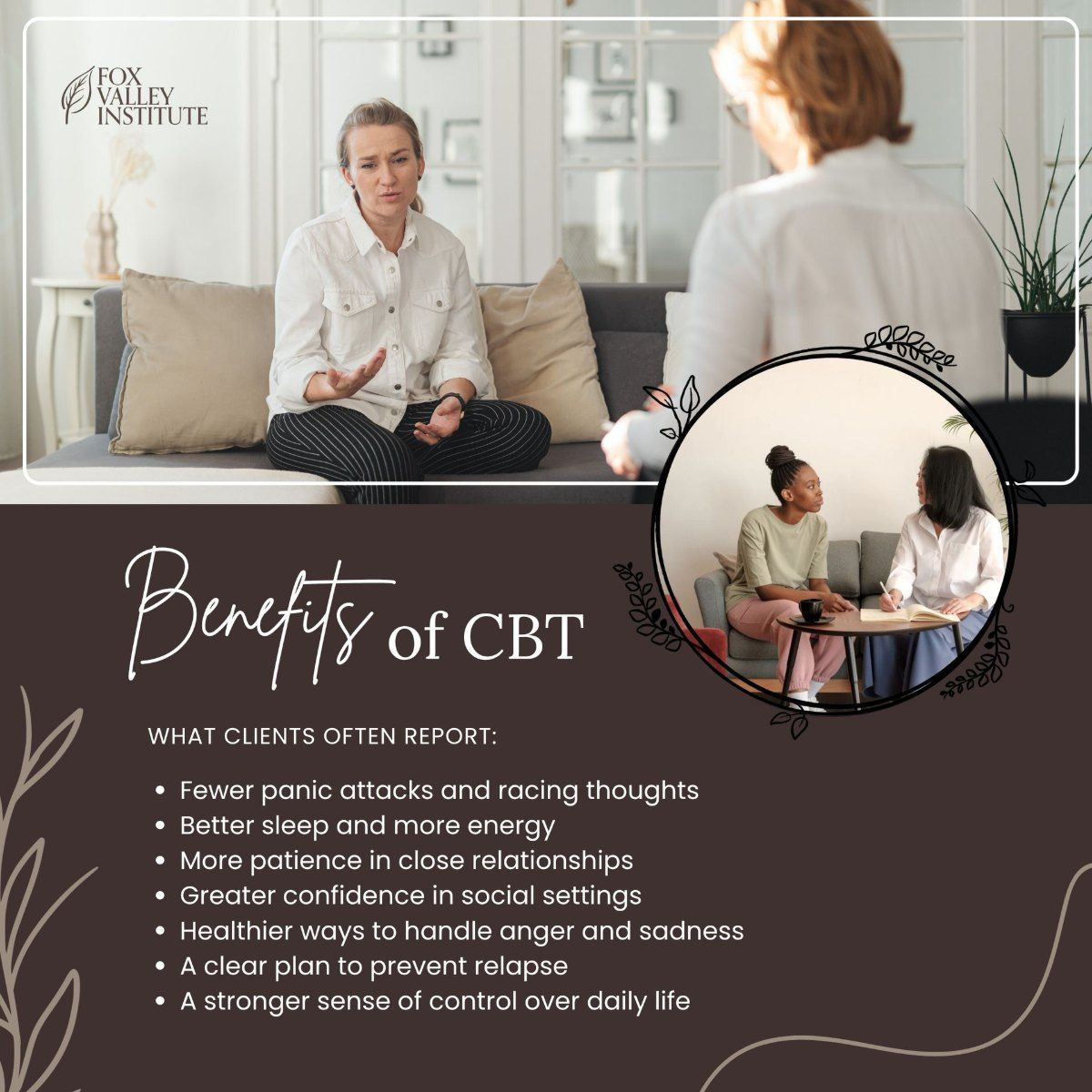
CBT does not just ease symptoms. It builds skills you keep for life. Many clients say they feel like “their own therapist” by the end of treatment.
Strengths of CBT
CBT has earned its reputation for clear reasons.
- Backed by science: more research supports CBT than almost any other talk therapy.
- Time-limited: most people see results in 12 to 20 sessions.
- Goal-focused: every session has a purpose and a plan.
- Skill-based: you leave therapy with tools you keep for life.
- Flexible: works in person, through online CBT, or as self-help.
- Adaptable: fits kids, teens, adults, and seniors.
- Strong relapse protection: skills reduce the risk of symptoms returning.
Limitations of CBT
No therapy works for everyone. Knowing CBT’s limits helps you decide if it is the right fit.
- Requires real effort outside of the session; homework is part of the process.
- Focuses on the present, not deep childhood roots.
- Can feel structured to people who want open-ended talk.
- Weekly sessions for months are a real time commitment.
- Severe trauma or dissociation may need EMDR or Brainspotting instead.
- Severe depression, bipolar disorder, or psychosis usually needs medication too.
CBT vs. Other Therapies (and Alternatives)
CBT is one strong tool among many. The best therapy depends on your goals, history, and personality.
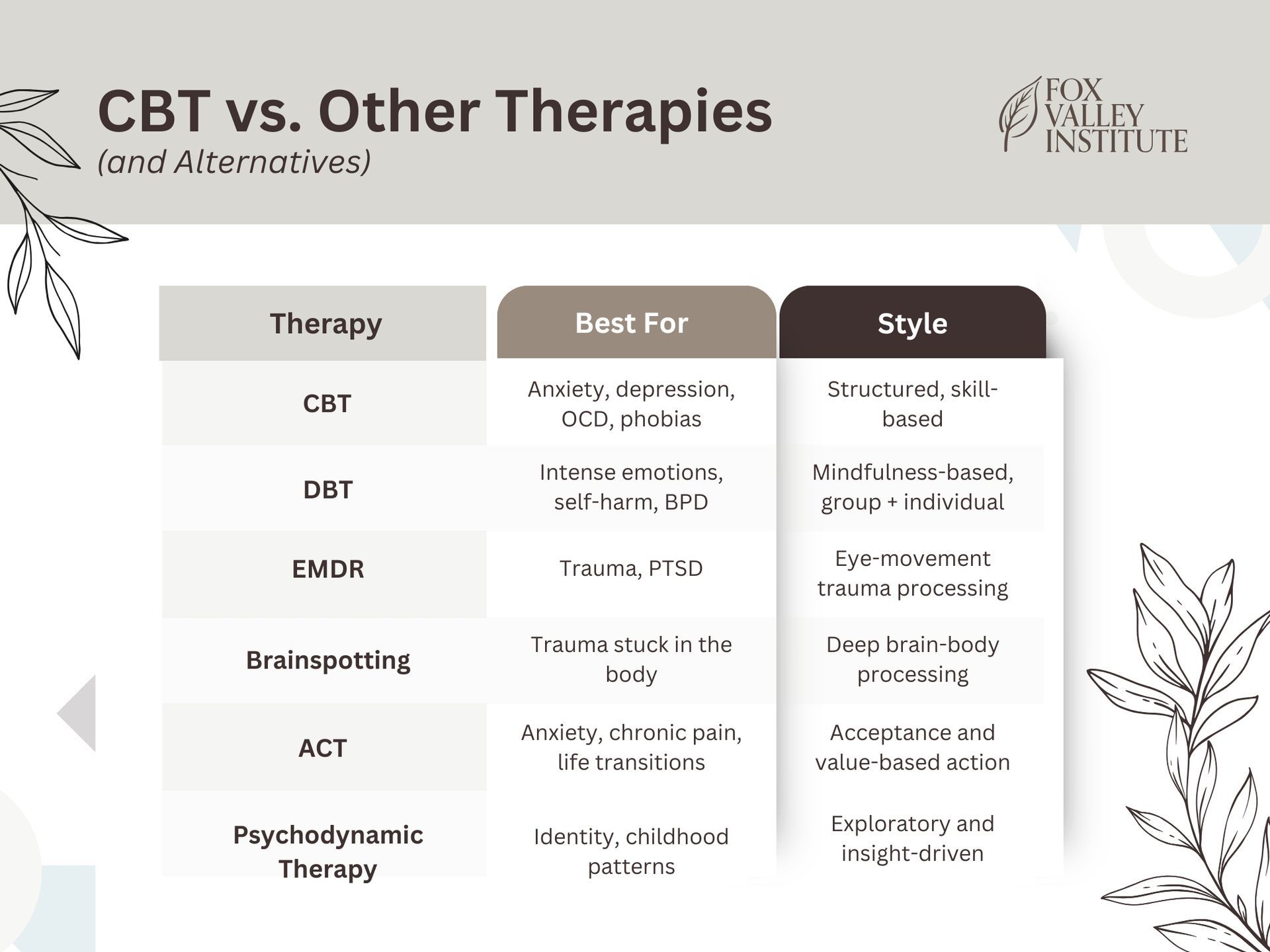
Alternatives to cognitive behavioral therapy include EMDR, Brainspotting, ACT, DBT, Rapid Resolution Therapy, and psychodynamic therapy. Fox Valley Institute offers all of these under one roof, so if CBT is not your fit, we will match you with one that is.
Considerations Before Starting CBT
CBT can change your life, but going in with the right mindset matters. A few things to think about before you book.
- Be ready to practice. Real change comes from doing, not just talking.
- Expect some discomfort. Facing fears or rethinking old beliefs is hard at first.
- Stay consistent. Weekly sessions for at least 8 to 12 weeks give the best results.
- Pick the right therapist. If your first match is not right, ask for another.
- Check your insurance. Most plans cover CBT — confirm before you start.
- Be honest. Your therapist can only help with what you share.
Where to Get Cognitive Behavioral Therapy in Naperville
Reaching out is the hardest step. We make the rest simple. Our team of psychologists, social workers, and licensed CBT therapists will pair you with a clinician who fits your style and goals.
We serve clients across Naperville, Aurora, Wheaton, Lisle, Plainfield, and the greater Fox Valley area. Both in-office and secure telehealth (online CBT) sessions are available across Illinois.
Book your first appointment:
- Call: (630) 718-0717
- Email: clientcare@fvinstitute.com
- Visit: 640 N River Rd Ste 108, Naperville, IL 60563
- Insurance: View accepted plans
Take the first step today. If anxiety, depression, trauma, or stuck thinking patterns are running your life, CBT can help you take back control.
Book a session with Fox Valley Institute and start building lasting change.
Find a therapist in Naperville
Visit our staff page and easily find a therapist that aligns with your unique needs and preferences.

What others say about us
Frequently Asked Questions About Cognitive Behavioral Therapy
What is Cognitive Behavioral Therapy (CBT)?
CBT is a structured form of talk therapy that looks at how your thoughts, feelings and actions affect each other. Your therapist helps you spot an unhelpful thought, test it against the evidence and replace it with a more balanced one.
Who can CBT help?
CBT is used for anxiety, depression, OCD, trauma, sleep problems, stress and low self-esteem. Our therapists use it with adults, teens, children and couples.
How long does CBT take?
It depends on you and your needs, so there is no set number of sessions. You and your therapist will talk about your progress along the way.
Can I do CBT by Telehealth?
Yes. Adults and college students anywhere in Illinois can do CBT by Telehealth and keep the same therapist. Counseling for children and teens takes place in person at our Naperville office.
Can I do CBT if I take medication?
Yes, CBT can be used alongside medication from your own doctor. Our therapists and psychologists do not prescribe or manage medication.
How do I get started with CBT?
Call (630) 718-0717. An intake coordinator will check your insurance, match you with a therapist and find an opening for your first appointment.