
What are Psychological Testing & Evaluation?
Psychological tests and evaluations are scientifically validated assessments and interviews conducted by licensed psychologists and therapists to assess behavior, personality traits, and cognitive abilities, diagnose mental health conditions, and determine the best course of treatment.
Often, the symptoms are very apparent, especially in children. Whereas in adults, the cause is not always clear, tests and evaluations like these are required.
These evaluations consist of:
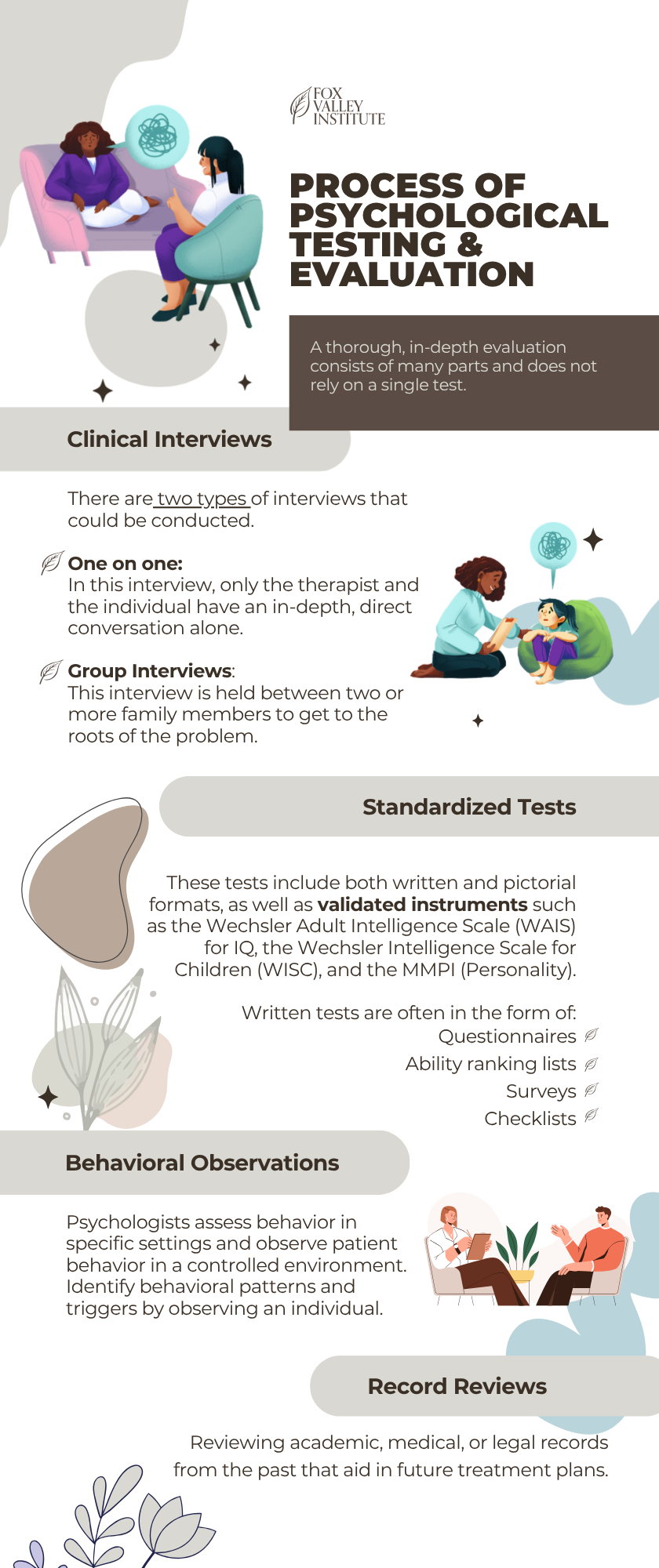
- Interviews
- Standard written and pictorial tests
That aids in diagnosing and determining appropriate treatment for clinical, educational, or forensic problems.
When Psychological Evaluation is Used?
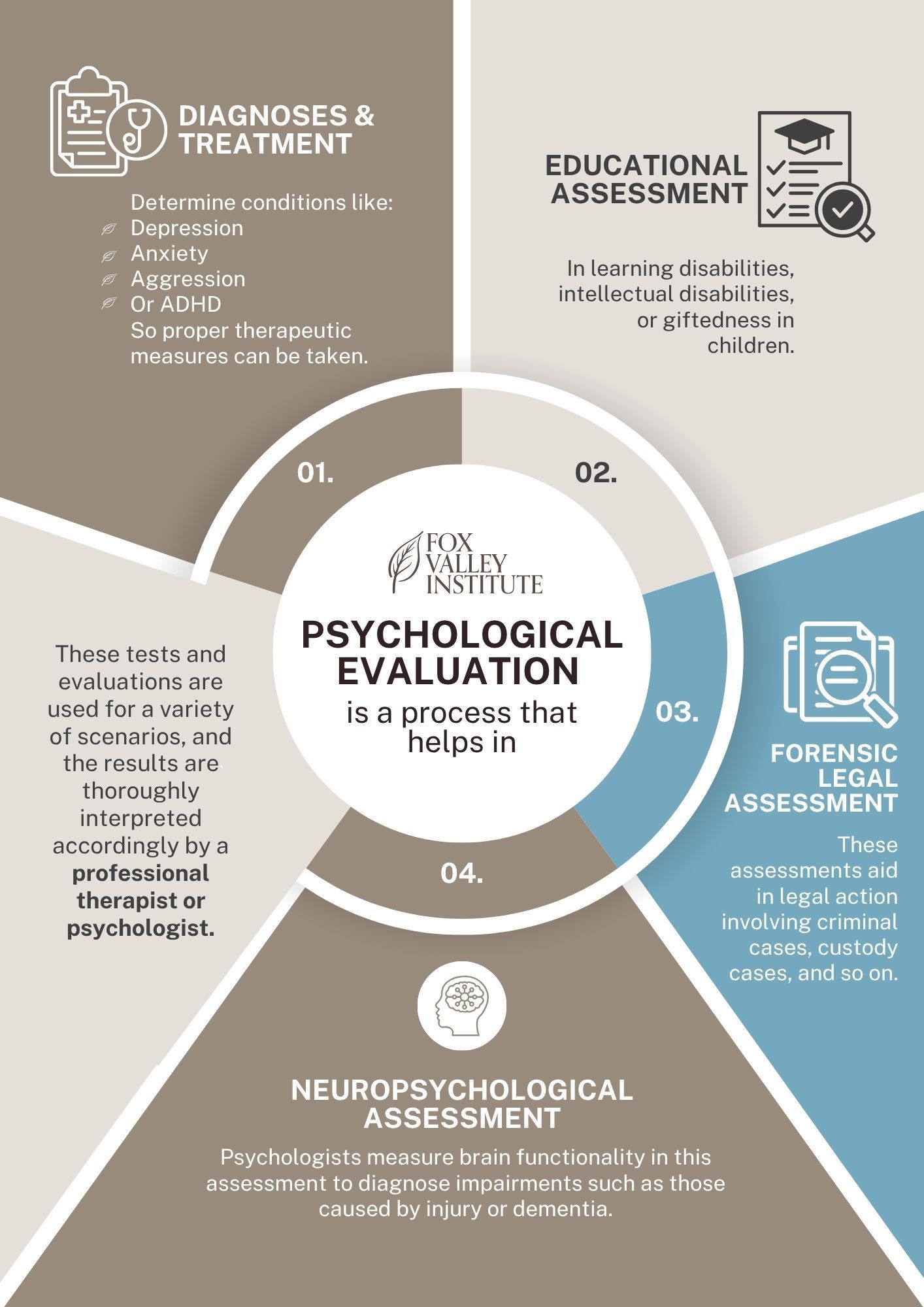
Who Should Get a Psychological Evaluation?
Not everyone needs a psychological evaluation, but there are certain situations where it really helps.
Sometimes the signs are loud, sometimes they’re quiet; but if something feels off for a long time, it’s worth looking into.
You might consider an evaluation if:
- You or your child has been feeling continuously sad, anxious, or angry without a clear reason
- A child is struggling in school despite trying their best
- There are sudden changes in behavior, sleep, or personality
- Memory problems have started after an accident or injury
- You’ve been through trauma, and the symptoms aren’t going away
- A custody case or legal matter requires a professional opinion
- A job role requires psychological stability screening
It’s not about labeling someone; it’s about understanding what’s going on so the right kind of help can be given.
How does the Evaluation Work?
Normally, these tests and evaluations are referred to by a medical doctor, social worker, or government employee and are conducted at a proper mental health hospital, facility, clinic, or university.
How to Prepare for a Psychological Evaluation?
The good news is, there’s no studying involved. But a little preparation can make the whole process smoother.
Here’s what helps:
- Get a good night’s sleep before the session, and you’ll think more clearly
- Eat properly; hunger affects focus
- Bring personal information and any medical records you have
- Make a list of medications you currently take
- Note down your main concerns so you don’t forget anything during the interview
- For children, bring school reports, teacher notes, and report cards if it’s an educational concern
- Be honest, not strategic; there are no right or wrong answers, only honest ones
For parents bringing a child: don’t coach them on how to answer. Just let them know they’re going to talk to someone who wants to understand them better.
Process of Psychological Testing & Evaluation
What are the Five Types of Psychological Tests?
The following tests are used during sessions based on the individual’s needs. Each test is designed for a specific purpose as described by the American Psychological Association:
Cognitive and IQ Tests
These measure memory, problem-solving, abstract thinking, and intellectual aptitude. These are also known as the “Intelligence Test” and are the most widely recognized.
They are mainly used to evaluate:
- Learning disabilities
- Intellectual giftedness
- Cognitive delays
Aptitude Tests
These measure one’s ability to perceive new information, whether intellectual, motor, or otherwise.
- Mechanical reasoning
- Verbal ability
- Numerical aptitude
- Clerical skills
These are the things measured through this test. Another beneficial aspect of aptitude tests is career guidance; an individual learns in depth where their strengths lie.
The following are two main tests that are used for assessments:
- General Aptitude Test Battery (GATB)
- Differential Aptitude Test (DAT)
Both batteries cover a broad range of aptitudes: verbal, numerical, mechanical, clerical, and abstract reasoning; though they differ in how the subtests are weighted and in the populations they were designed for.
Personality Tests
These help identify an individual’s personality traits and emotional functioning. The professional assesses how a person feels, thinks, and behaves in a range of situations.
These tests are in questionnaire form, where personality traits and psychopathology are evaluated.
Self-Report Assessments
In a self-report assessment, the individual answers questions about their own thoughts, feelings, and behavior.
The MMPI (Minnesota Multiphasic Personality Inventory) is one of the most widely used examples in clinical psychology practice and is applied in areas like:
- Clinical diagnosis of psychopathology
- Forensic and child custody evaluations
- Occupational screening for psychological stability
Individuals are also given projective tests, such as incomplete-sentence, image, or inkblot tests, to respond to.
This is what analyzes a deeper unconscious level of fear, motivation, and feelings.
Best known examples of these tests are:
- The Rorschach Inkblot Test
- Thematic Apperception Test (TAT)
Achievement Assessments
It’s a bit of a different approach than others. It’s basically the data of what an individual already knows and how they perceive that information.
These tests measure acquired knowledge in areas such as reading, writing, and mathematics and are commonly used in school placements and to identify learning disabilities.
Well-known examples include the
Wechsler Individual Achievement Test (WIAT) and the Woodcock-Johnson Tests of Achievement.
Neuropsychological Tests
These tests measure how the brain is functioning: memory, attention, language, problem-solving, and motor skills; to detect impairments caused by injury, stroke, dementia, or developmental conditions.
They are often used after a head injury, during recovery from a stroke, or when cognitive decline is suspected, to give psychologists a clear picture of which brain functions are affected and which are intact.
These 5 main tests evaluate everything from conscientiousness to neuroticism, providing a thorough, in-depth understanding to create a proper treatment plan.
Procedure of a Psychological Session
The whole evaluation process consists of an interview, tests, and a final treatment plan.
- Interview Session: It helps gather background information and lasts up to 60 minutes.
- Testing Sessions: In-person testing, often spanning 3–7 hours across one or more sessions.
- Feedback Session: A final appointment to review a written report with results, recommendations, and treatment.
The information gathered through tests and interviews is used by psychologists to make accurate diagnoses, develop a treatment plan, and provide referrals.
What Happens After the Evaluation?
Once the testing is done, the work isn’t quite over. The psychologist takes time to interpret everything carefully, usually 4 to 6 weeks, and then comes the feedback session.
In this final session, you receive a written report that includes:
- A summary of the tests taken
- The results and what they mean
- A diagnosis (if applicable)
- Recommendations for treatment, therapy, or further assessments
- Referrals to specialists if needed
This report can be shared with your doctor, school, court, or employer, but
only with your consent. The findings then become the foundation of your treatment plan, whether that means therapy, medication, classroom accommodations, or lifestyle changes.
It’s not the end of the road; it’s actually the beginning of a clearer one.
How Psychologists Choose the Right Test
To get the whole picture, professional therapists and psychologists don’t rely on a single test. Sometimes two different tests are taken, and sometimes all five are taken to improve understanding and ensure reliable treatment.
For example, a psychologist may use a projective test and an intelligence test with a student who is struggling academically. Or a psychologist may take neuropsychological tests and personality tests for someone who has gone through intense trauma.
In the end, it all depends on the individual’s needs and how a professional sees fit to gather information for treatment.
Psychological Testing for Children vs. Adults
The approach varies widely by age, and that’s a good thing; kids and adults aren’t going through the same things, so the tools shouldn’t be the same either.
For Children:
- Tests like the WISC (Wechsler Intelligence Scale for Children) are used
- Sessions are shorter and broken into smaller parts, so kids don’t get tired
- Input from parents and teachers plays a big role
- Often includes play-based observation for younger ones
For Adults:
- Tests like the WAIS (Wechsler Adult Intelligence Scale) are used
- Sessions can be longer, more in-depth
- Self-reporting is more central
- Medical and life history weigh heavily in the results
Children may also be tested through their school system, while adults usually go through clinics or private psychologists.
Difference Between Psychological Testing and Psychiatric Evaluation
A lot of people use these terms like they mean the same thing, but they don’t.
Psychological Testing:
- Done by a licensed psychologist
- Includes interviews, written tests, and observations
- Focuses on diagnosing conditions and understanding behavior
- Outcome: a detailed report with a treatment plan
Psychiatric Evaluation:
- Done by a psychiatrist (a medical doctor)
- Mostly involves a clinical interview
- Focuses on whether medication is needed
- Outcome: a prescription or medication plan, if required
Sometimes both are needed; the psychologist diagnoses and plans therapy, and the psychiatrist handles the medical side. They work hand in hand, not against each other.
Common Myths About Psychological Testing
There’s a lot of misinformation around psychological testing, and it stops people from seeking the help they actually need. Let’s clear some of it up.
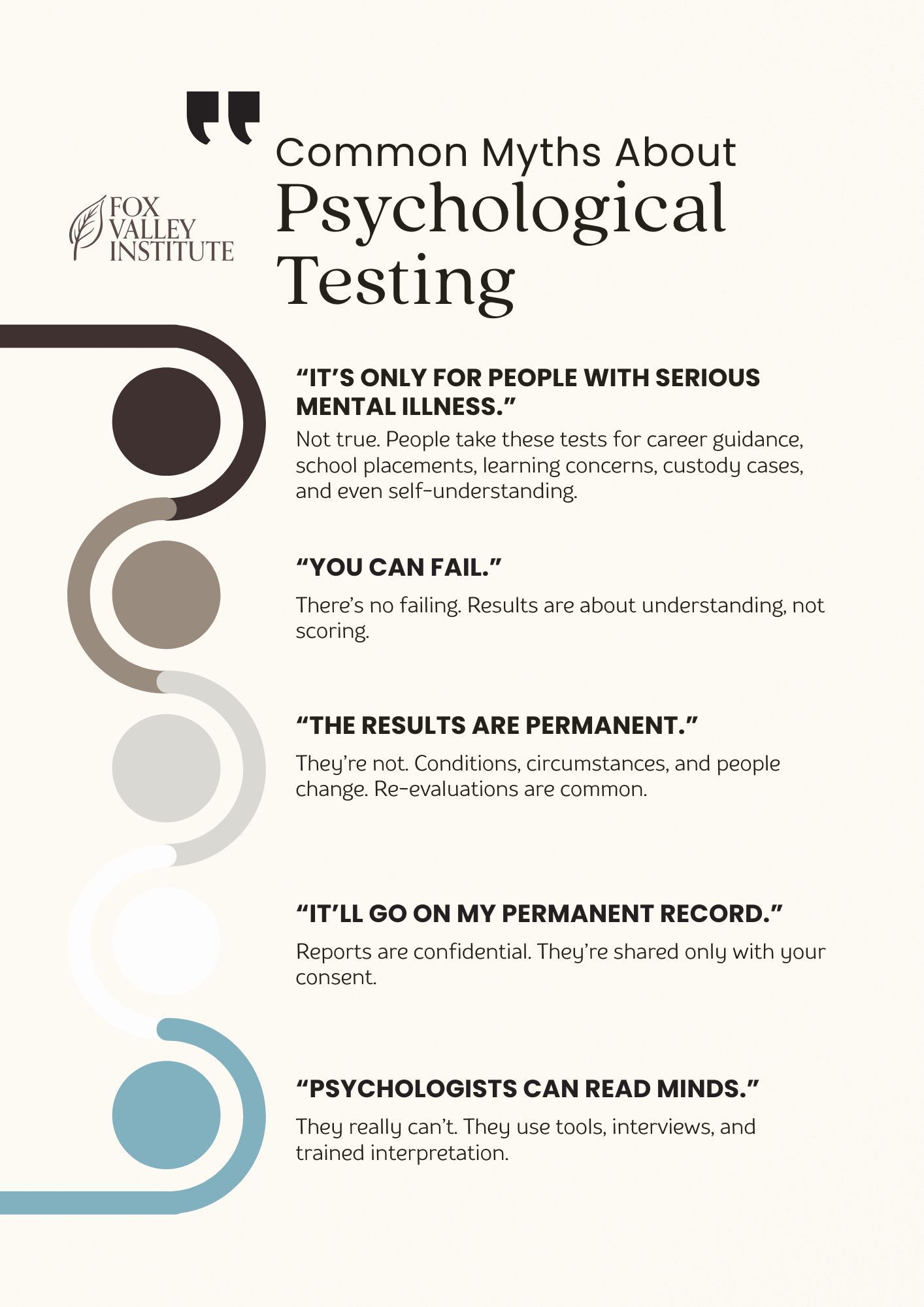
The more these myths fall apart, the easier it becomes for people to get the help they deserve.
Related Conditions Often Diagnosed Through Evaluation
Psychological testing helps in identifying a wide range of conditions, each with its own treatment path. Some of the most common ones include:
- ADHD Attention Deficit Hyperactivity Disorder
- Autism Spectrum Disorder (ASD)
- Learning Disabilities, such as dyslexia, dyscalculia, dysgraphia
- Dementia and other memory-related conditions
- Depression and Anxiety Disorders
- PTSD Post-Traumatic Stress Disorder
- Personality Disorders
- Intellectual Disabilities
Getting the right diagnosis is the first real step toward the right kind of support.
Glossary of Common Terms
A few terms often come up in psychological testing, and knowing them can make the whole process less confusing.
- Psychometrics: the science of measuring mental abilities and traits
- Validity: whether a test actually measures what it claims to measure
- Reliability: whether a test gives consistent results over time
- Percentile: how a score compares to others (e.g., 80th percentile means scored higher than 80% of people)
- Standard Score: a way of comparing results to an average
- Projective Test: a test where ambiguous images or sentences reveal unconscious thoughts
- Battery: a set of multiple tests given together for a complete picture
These terms come up a lot in your final report, so it’s good to know what they mean.
Important Things to Keep In Mind About Psychological Tests & Evaluation
It’s Not Just a Pass or Fail Examination:
Results provide a profile of strengths and weaknesses, not a grade. They are not about passing or failing. No prior study or any preparation is required for these tests. The only way to get the best results is to be honest and mindful when answering.
Time Commitment:
The entire process from interview to testing to feedback can take 12–15 hours of clinician time, with reports often provided 4–6 weeks later.
Expert Administration:
Licensed clinical psychologists or neuropsychologists administer tests. It is necessary to share your medical history as well for an accurate diagnosis.
These results are interpreted carefully, considering context, limitations, and professional judgment.
“Psychological tests and evaluations provide structured ways to understand behavior, abilities, and mental processes, but they are not perfect measures.”
FAQs
What are the five types of psychological tests?
Each of the five types of psychological tests was designed to evaluate how a person feels, thinks, and perceives things.
These tests are:
- Intelligence
- Aptitude
- Personality
- Achievement
- Neuropsychological
What are the 7 steps of psychological assessment?
Any psychological procedure is done in steps to gather in-depth information, like:
- Formulating goals
- Identifying tools and techniques according to an individual’s needs
- Collecting data through tests
- Interpreting specific data
- Integrating data from different sources, like interviews and different tests
- Formulating assessment information
- Reformulating goals as needed
What are the 5 P’s of psychological assessment?
Professional therapists and psychologists basically use the 5 P’s to assess clients and patients:
- Presenting problem
- Predisposing factors
- Precipitating factors
- Perpetuating factors
- Protective factors
What are the 7 types of psychology?
The following are the major recognized branches of psychology:
- Clinical Psychology
- Cognitive Psychology
- Developmental Psychology
- Social Psychology
- Forensic Psychology
- Industrial-Organizational (I-O) Psychology
- Neuropsychology
What are the Big Five personality traits?
The Big Five model identifies five traits that help in mental health evaluations. Those are:
- Openness
- Conscientiousness
- Extraversion
- Agreeableness
- Neuroticism
How long does a psychological evaluation take?
The full process usually takes 12–15 hours of clinician work, spread across one or more sessions. The actual testing time for the patient is typically 3–7 hours, with reports ready in about 4-6 weeks.
Does insurance cover psychological testing?
It depends on your plan. Many insurance providers cover testing if there’s a medical referral, but coverage varies. Always confirm with your provider before scheduling.
Can I take a psychological test online for free?
There are free online tests, but they’re not the same as a clinical evaluation. They can provide a rough idea, but only a licensed psychologist can make a formal diagnosis.
What’s the difference between a psychologist and a psychiatrist?
A psychologist focuses on testing, therapy, and behavioral treatment. A psychiatrist is a medical doctor who can diagnose and prescribe medication. Both can work together for full care.
Can children be evaluated for mental health?
Yes, and often it’s the best thing parents can do. Early evaluations help identify learning, behavioral, or developmental concerns when treatment is most effective.
How accurate are personality tests?
Standardized personality tests like the MMPI are highly reliable when used by a trained psychologist. Casual online quizzes are not; they’re for fun, not diagnosis.
Will my employer find out about my evaluation?
Not unless you choose to share the results. Reports are confidential and protected by law in most places.
Can I refuse a psychological evaluation?
In most cases, yes. The exception is court-ordered evaluations, where refusal can have legal consequences.
How often should someone be re-evaluated?
It depends on the condition. For learning disabilities, every 3 years is common. For mental health concerns, re-evaluation happens whenever symptoms or circumstances change.